
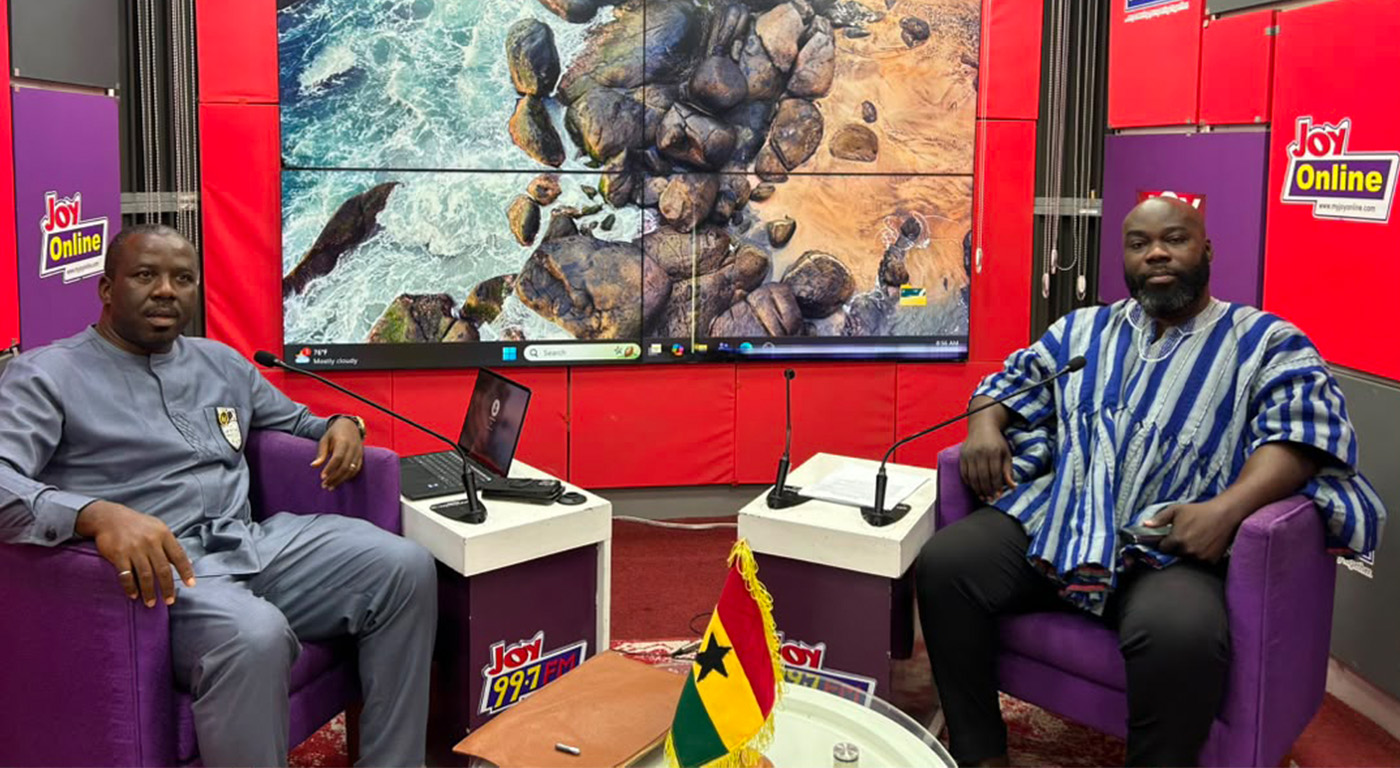

The Ghana Institution of Engineering (GhIE) has called for a fundamental shift in the country’s approach to road infrastructure, urging policymakers to prioritise the maintenance and effective management of existing roads alongside the construction of new ones.
Vice President and Chair of the Public Accountability Committee of GhIE, Ing Dr. Patrick Amoah Bekoe, attributed the deterioration of Ghana’s road network to inadequate funding, weak maintenance regimes and poor asset management.
Speaking on the Joy FM Super Morning Show on Thursday, August 13, 2026, as part of Joy Sustainability Month, Ing Dr. Amoah Bekoe said Ghana’s road infrastructure had declined from Grade D3 in 2016 to Grade E1 in the 2026 Ghana Infrastructure Report Card, placing the sector in the poor performance category.
He said the decline should serve as a wake-up call for the country to reconsider how it plans, funds and manages road infrastructure.
According to Ing Dr. Amoah Bekoe, Ghana’s infrastructure policy has traditionally placed greater emphasis on new road construction, often at the expense of preserving existing assets.
“Our leaders are much more interested in what I call ‘ribbon-cutting projects’ to show that I’ve done this kilometres of road, but not in preserving the assets that we have,” he said.
He explained that infrastructure should be treated as a long-term national asset requiring continuous investment in maintenance to protect the value of public expenditure.
He noted that when maintenance is deferred until roads have significantly deteriorated, government is eventually forced to undertake expensive rehabilitation or reconstruction.
“We are interested in new roads instead of preserving what we have. And so we wait for the new ones to deteriorate, and then we’ll do new construction,” he said.
Ing Dr. Amoah Bekoe identified inadequate and inconsistent funding as one of the major factors affecting road maintenance.
He cited significant arrears owed to road contractors, saying that, based on the data assessed, arrears stood at more than GH¢17 billion as of the end of 2014.
He said such funding challenges affected contractors’ ability to sustain work, resulting in situations where road projects remained incomplete or were left without contractors for extended periods.
He also pointed to the use of resources intended for routine maintenance for major rehabilitation works as a concern.
“The Road Fund is supposed to be used for road maintenance,” he said, adding that it was often used for major rehabilitation instead.
He therefore stressed the need for a predictable and sustainable financing framework that would allow road agencies to undertake routine maintenance before deterioration reached critical levels.
The GhIE Vice President also raised concerns about overloaded vehicles and their impact on the durability of Ghana’s road network.
“When we have these overloaded trucks, it aggravates the loading on our roads and deterioration of our roads,” he said.
He warned that failure to effectively manage axle loads could undermine significant public investments in road infrastructure.
“If we are not able to manage that as a country, I think we are basically destroying the investment that you and I, the taxpayers, have made on our roads,” he added.
Ing Dr. Amoah Bekoe emphasised that the consequences of poor road infrastructure extend beyond the physical condition of roads.
He said deteriorating roads increase travel times, reduce productivity and impose additional economic costs on households and businesses.
“When you are coming to work, because of the nature of the roads, instead of spending 45 minutes, you spend two hours,” he said.
He explained that such delays represented hidden economic costs because infrastructure that should facilitate productivity instead becomes a constraint on economic activity.
Ing Dr. Amoah Bekoe called on the media and the public to broaden the way they assess government performance in the road sector.
He urged journalists to ask political leaders not only about the number of new roads constructed but also about how existing roads were being maintained and protected.
“We want the media to help us,” he said, stressing the importance of sustained public attention to infrastructure maintenance.
He said greater scrutiny of maintenance commitments would encourage policymakers to treat infrastructure as a long-term national asset rather than focusing primarily on highly visible new projects.
The GhIE Vice President welcomed the restructuring of the Road Fund into a Road Maintenance Trust Fund, describing it as a potentially important step towards improving road maintenance financing.
“We are happy that the current minister and the current government is actually looking towards that direction,” he said.
“They have restructured the Road Fund to a Road Maintenance Trust Fund, and they are doing things differently. So we hope that we will have a different trajectory going from now.”
He, however, stressed the importance of effective implementation to ensure that the new arrangement delivers sustainable improvements in road maintenance.
Ing Dr. Amoah Bekoe clarified that the 2026 Ghana Infrastructure Report Card was not designed to assess or target any particular political administration.
Rather, he said, the assessment examined the overall condition of Ghana’s infrastructure and the systems and practices through which infrastructure had been planned, financed, operated and maintained.
“This is not an assessment of any government; it’s an assessment of the state; it’s an assessment of the way we have done things,” he said.
The 2026 Ghana Infrastructure Report Card therefore provides an opportunity for policymakers, infrastructure professionals, development partners, the media and citizens to examine long-term trends and identify the reforms required to improve Ghana’s infrastructure performance.