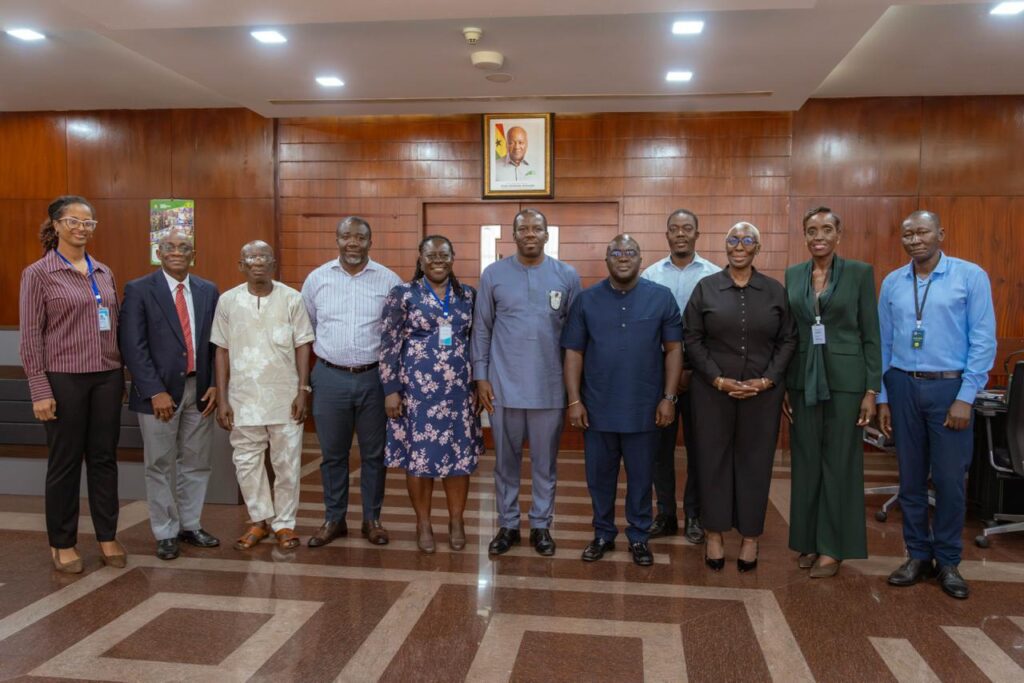

Chief of Staff Julius Debrah has proposed a government round-table discussion to consider the recommendations of the Ghana Institution of Engineering’s (GhIE) 2026 Ghana Infrastructure Report Card and explore measures to address Ghana’s infrastructure challenges.
Mr Debrah made the proposal on Thursday, 1 October 2026, when a GhIE delegation presented the 2026 Ghana Infrastructure Report Card to the Presidency at the Jubilee House in Accra.
The GhIE delegation was led by Vice President Ing Dr Patrick Amoah Bekoe and included Ing Yaa Obenewaa Okudzeto, Chair of the Ethics Committee; Ing Dr Enyonam Kpekpena, Executive Director; Mr Philip Aheto Executive representative Technicians; Ing Dr Michael Bekoe, Chair of the Membership Committee; Ing Leonora Otu-Boateng, Director of Professional Practice; Nii Odenkey Abbey, Communications and Public Relations Manager; and Kofi Gyamera Brefo, Digital Communication Officer.
The delegation was received at the Presidency by Mr Debrah, Economic Adviser to the President Seth Terkper, and Legal Counsel to the President Marietta Agyeiwaa Brew, who represented the Presidency during the engagement.
The presentation formed part of GhIE’s ongoing stakeholder engagements following the launch of the 2026 Report Card, which assesses the condition and performance of Ghana’s critical infrastructure and provides recommendations to support infrastructure planning, investment and policy decisions.
During the meeting, GhIE briefed the Presidency on the report’s findings and highlighted infrastructure risks associated with inadequate investment, maintenance and asset management.
The Institution stressed that infrastructure development should extend beyond the construction of new facilities, noting that sustained investment in operation, maintenance, rehabilitation and long-term asset management is necessary to protect public infrastructure and reduce the cost of future rehabilitation.
GhIE also highlighted the potential consequences of inadequate maintenance, including declining service quality, increased safety risks, reduced economic productivity and higher costs to government and the public.
The 2026 Report Card builds on GhIE’s earlier infrastructure assessment and provides an updated assessment of key sectors, including roads and bridges, electricity, education, railway, telecommunications, potable water, health and aviation. The assessment is intended to provide an engineering-based evidence base for national decision-making and infrastructure planning.
The Institution has been engaging political leaders and other national stakeholders on the findings and recommendations of the report as part of efforts to promote wider dialogue on Ghana’s infrastructure needs.
GhIE reiterated its readiness to work with government and other stakeholders to translate the report’s recommendations into practical interventions aimed at improving infrastructure delivery, strengthening asset management and ensuring that Ghana’s infrastructure remains safe, resilient and fit for purpose.