
Presidential Adviser on the 24-Hour Economy and Accelerated Export Development, Augustus Goosie Tanoh, has called on Ghana’s engineering community to take a leading role in driving the country’s next phase of economic transformation.
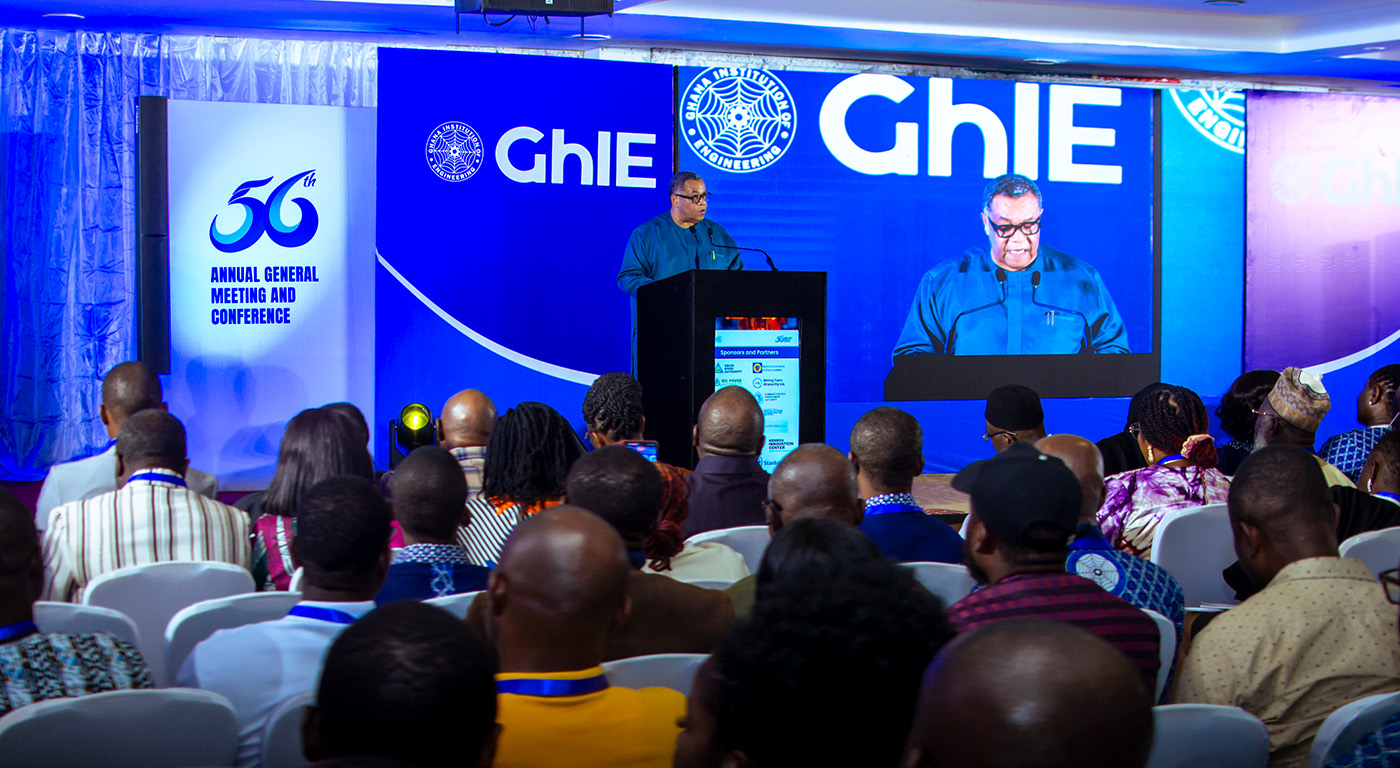
Delivering a keynote address on behalf of President John Dramani Mahama at the 56th Annual General Meeting and Engineering Conference of the Ghana Institution of Engineering (GhIE), Mr. Tanoh emphasized that engineering must move from the margins to the center of national development strategy.
Addressing participants at the Volta Serene Hotel in Ho, he described the engineering profession as the backbone of the government’s 24-Hour Economy agenda. He noted that while Ghana has a strong base of technical expertise across multiple disciplines, the critical challenge lies in scaling this capacity through improved systems, access to finance, and coordinated industry action.
Mr. Tanoh expressed concern over the growing reliance on administrative responses to challenges that require engineering solutions. Citing recurring flooding in urban centers such as Accra, he observed that although technical designs for drainage and stormwater systems exist, implementation has been limited. He urged engineers to play a more assertive role in national decision-making and advocate for the execution of practical, infrastructure-driven solutions.
He also highlighted structural constraints within the private sector, where many local firms operate as intermediaries on major projects. While this model may yield short-term gains, he noted that it restricts skills transfer and long-term capability development. He encouraged Ghanaian firms to prioritize technical capacity, form strategic partnerships, and position themselves to lead project execution.
Linking his remarks to the conference theme, “Engineering the Food Security and Sustainable Agriculture Value Chain,” Mr. Tanoh described Ghana’s rising food import bill as both a challenge and an opportunity. He identified inefficiencies in storage, processing, transportation, and energy systems as key gaps that require engineering solutions to reduce post-harvest losses and strengthen domestic production.
He further outlined opportunities under the 24-Hour Economy programme, including agro-processing corridors, industrial parks, renewable energy projects, and inland water transport along the Volta Lake. These, he said, are designed to expand local participation while building long-term technical capacity.
Mr. Tanoh also emphasized ongoing policy reforms to strengthen procurement systems and support industrial development, alongside the need to align engineering education with industry demands.
He concluded by urging engineers at all levels to rise to the challenge, stressing that Ghana’s transformation will ultimately depend on the ability of its engineering sector to deliver practical, scalable solutions.